
Western Digital WD80EAAZ Data Recovery: Abnormal Noise and No Detection
Case Studies
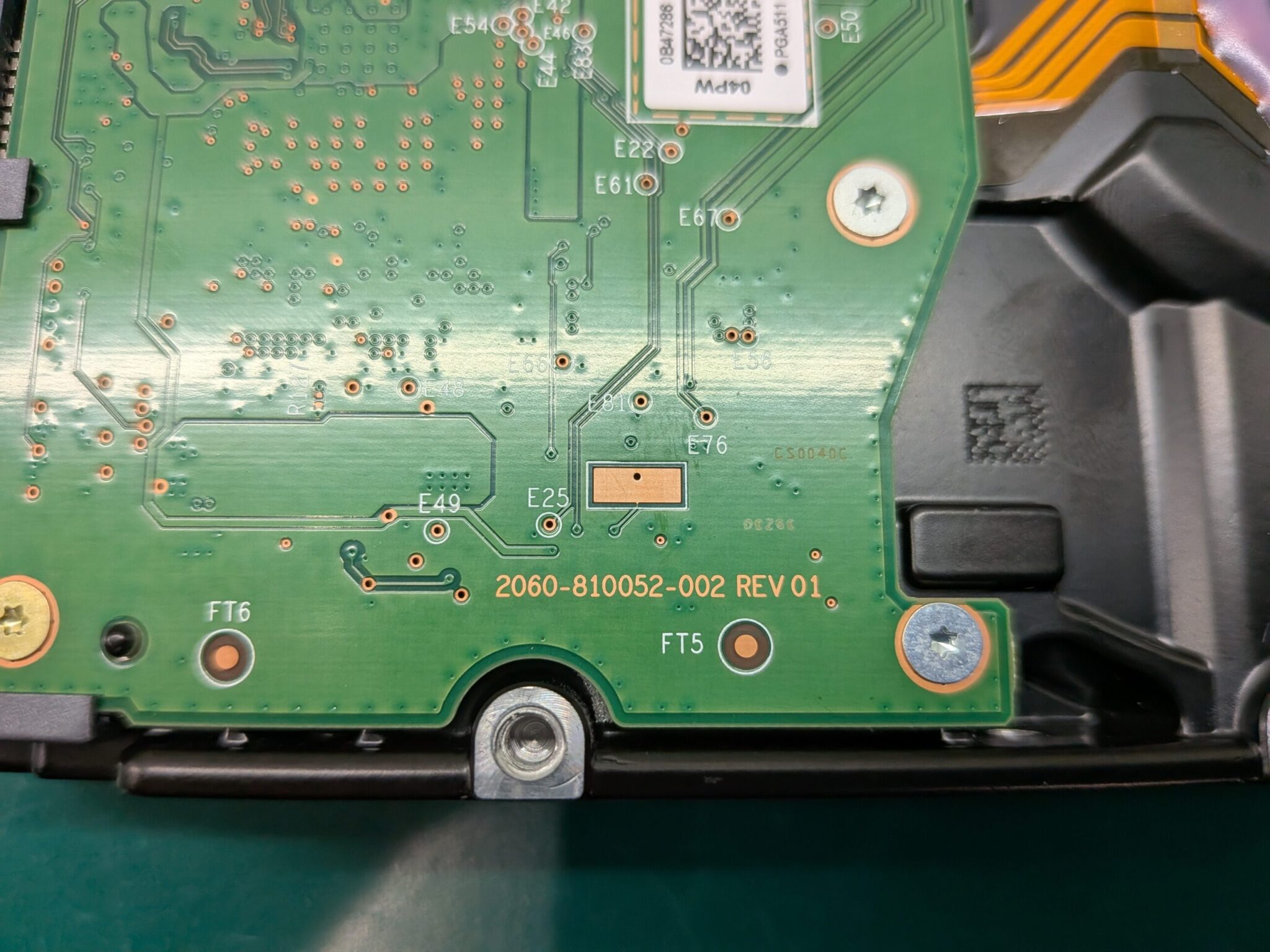
Case Overview
| Item | Details |
|---|---|
| Recovery target | Western Digital WD80EAAZ-00BXBB0, 8 TB |
| Symptoms | Abnormal noise after power-on; not detected; repeated restart cycle |
| Diagnosis | Firmware failure |
| Severity | Moderate |
Initial Diagnosis and Recovery Process
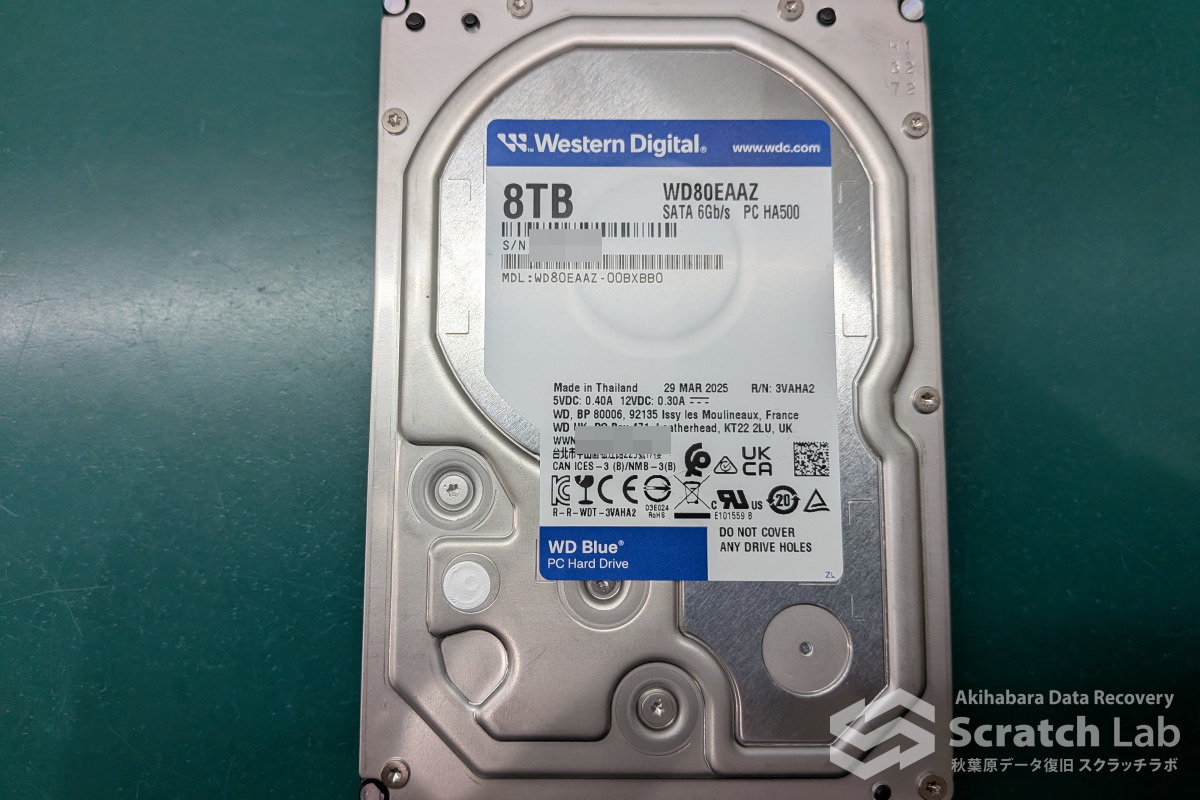
Initial Diagnosis
The HDD was sent to us after another provider had declared it unrecoverable. The reported symptom was an abnormal noise after power-on. The seal covering the enclosure screw was intact, confirming that the drive had not previously been opened.
Abnormal Noise During Power-On
The audio below captures the sound produced when the HDD was powered on. There is some background noise—headphones may make it easier to hear—but the drive emits several distinct high-pitched beeps.
This type of sound is often assumed to indicate failed read/write heads, including by data-recovery providers. A careful look at the HDD’s startup sequence, however, suggested that the heads were not necessarily the primary problem.
As described in our guide to recovery from scratched or damaged platters, a completely failed head cannot acquire the servo-positioning information on the platter. In that situation, mechanical seeking noises normally begin earlier in the startup sequence.
Here, the beeping occurred later. Although the distinction is difficult to hear in the recording, the timing suggested that the failure was more likely occurring while the drive attempted to load firmware.
That did not rule out head degradation entirely. A head can still function partially yet be too weak to read the firmware reliably. The startup timing nevertheless gave us a much narrower diagnostic target.
Addressing the Firmware Failure
After narrowing down the likely cause, we applied a method to bypass the firmware problem. We cannot disclose the exact procedure because relatively few providers currently support this model.
The firmware architecture contains a subtle feature not found in earlier Western Digital drives, and recognizing it was the key to this recovery. Once the firmware issue had been addressed, the HDD remained comparatively stable and we were able to image it without incident.
Recovery Result and Engineer’s Notes
Data Extraction and Recovery Result
We recovered 100% of the sectors on the drive, with no bad sectors remaining in the image. No head replacement was required, so despite the abnormal sound, the heads can be considered fully functional.
The result was excellent: approximately 110,000 intact files totaling 7.1 TB were recovered.
From the Engineer
Like the two WD cases published immediately before this one, the WD80EAAZ belongs to the AvalonRP family. This case was resolved by overcoming a firmware failure rather than replacing the heads.
If you are experiencing a similar problem with this HDD model, contact Scratch Lab for an assessment.
About the Author

A.N
Certified Information Security Specialist. Began career as a technical officer with the National Police Agency, specializing in digital forensics. Recipient of multiple commendations, including the Director of Information and Communications Bureau Award and the Commandant's Award from the NPA Information and Communications School.
Subsequently joined a major data recovery firm before moving to FIX Inc., where he handles the full recovery workflow — from logical to physical failures — across HDD, SSD, flash memory, and RAID systems. His specialty is severe physical damage to HDDs; he manages nearly 100 scratch damage cases annually, successfully recovering data in the majority of them.