
Data Recovery from a Clicking Seagate ST31000520AS
Case Studies
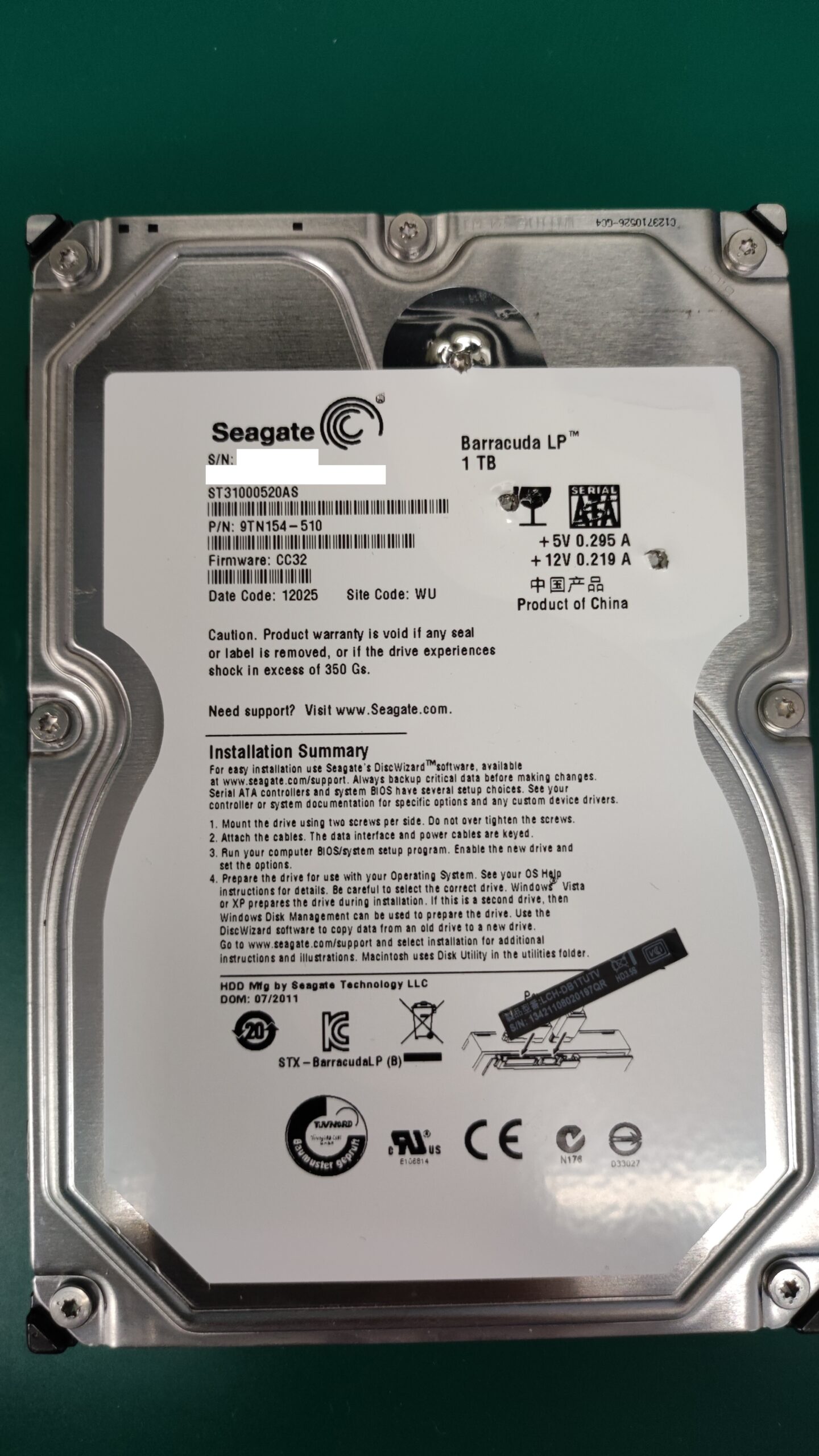
Overview
This case involved a Seagate ST31000520AS HDD. The model is notorious among recovery engineers for producing large amounts of debris when its platters become scratched. It belongs to Seagate’s Hepburn family—one of three families, along with Pharaoh and Brinks, especially known for this type of extensive magnetic debris.
Extreme Platter Damage Previously Declared Unrecoverable (May 2024)
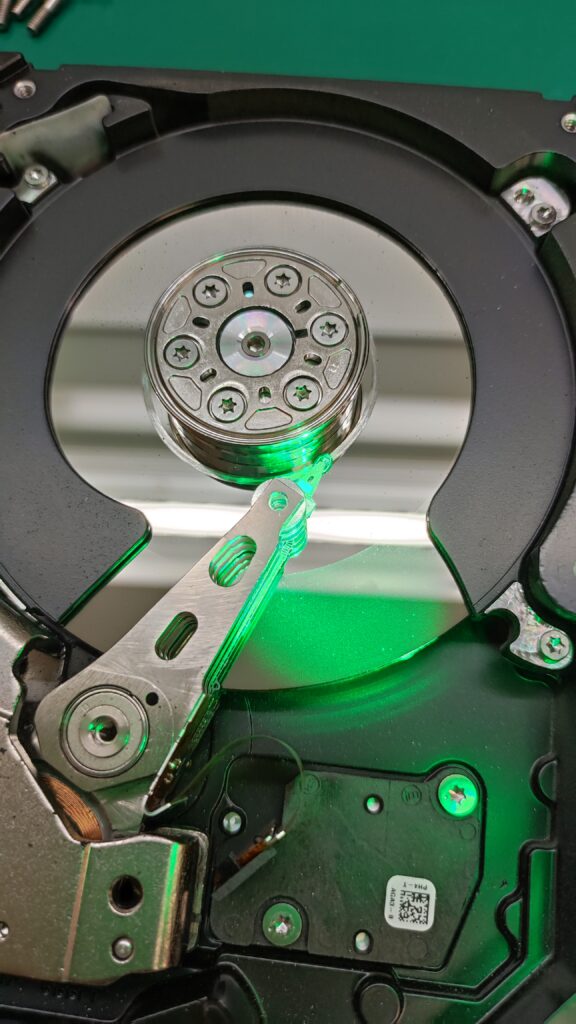
Symptoms and Diagnosis
The HDD arrived already opened after another provider had declared it unrecoverable. Internal inspection confirmed extensive platter scratches and magnetic coating damage.
Turnaround Time
Approximately one month
Recovery Result
- Approximately 290 GB of intact files, around 300,000 files
- Approximately 260 GB of damaged files, around 3,500 files
- Approximately 260 GB of unrecoverable files, around 40,000 files
For this report, a damaged file is one that contains at least one read error. Depending on the location and extent of the missing data, it may still open. An unrecoverable file has an error at or near its beginning and cannot be opened.
Recovery Process
Because the HDD had already been opened, we took it directly to the clean bench. When we removed the cover, the interior was so heavily contaminated that merely touching it turned our gloves black.
The photograph shows a deep scratch near the inner area of the silver platter. The outer half is coated in debris generated when the read/write heads scraped the recording surface. The small black specks across the platter are also debris from the damaged magnetic coating.
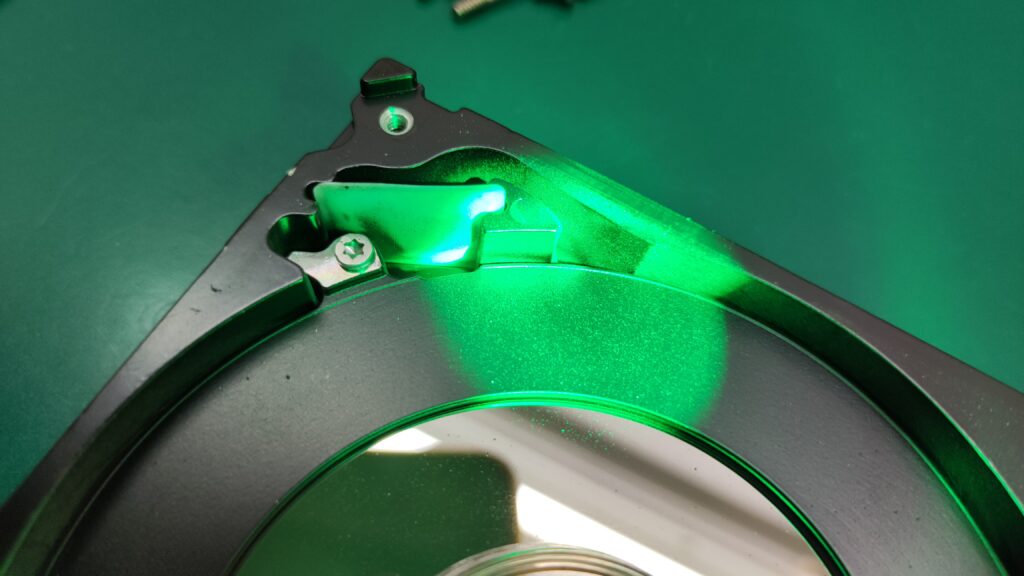
The filter pocket contained a large quantity of debris.
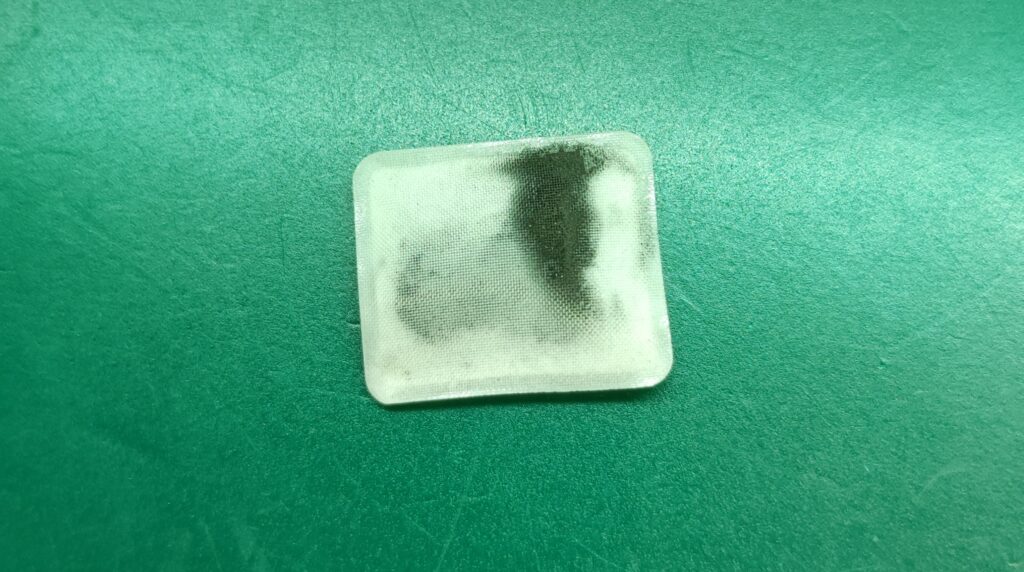
The filter itself had also become heavily blackened.
This drive contains two platters. When we inspected the lower platter, we found the following condition.
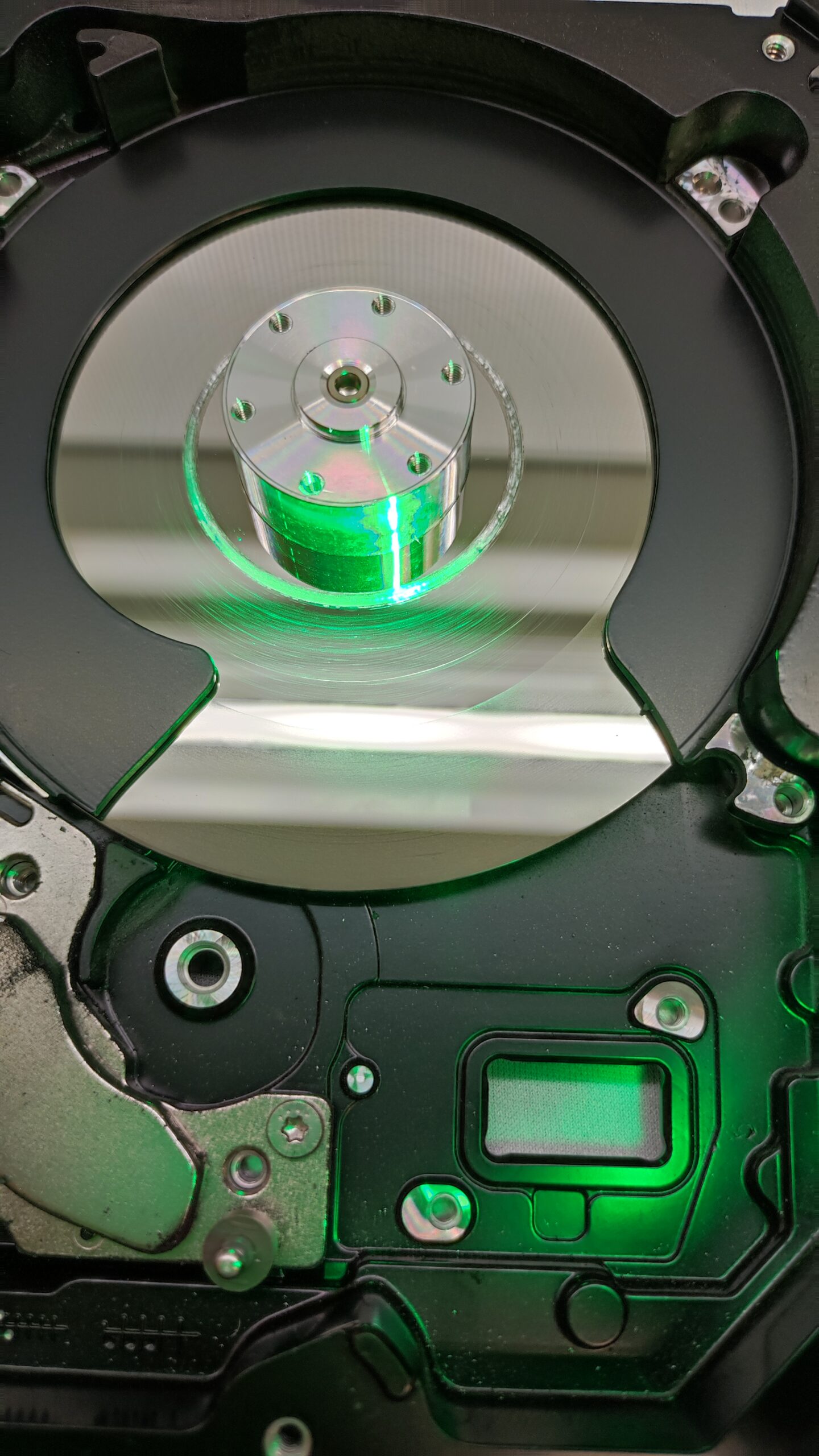
Like the upper platter, its outer area was covered in debris, while the inner area was even more severely damaged. Replacing the heads without first removing this contamination would have caused the new heads to fail almost immediately and could have spread the damage further. We therefore began by cleaning the platters.
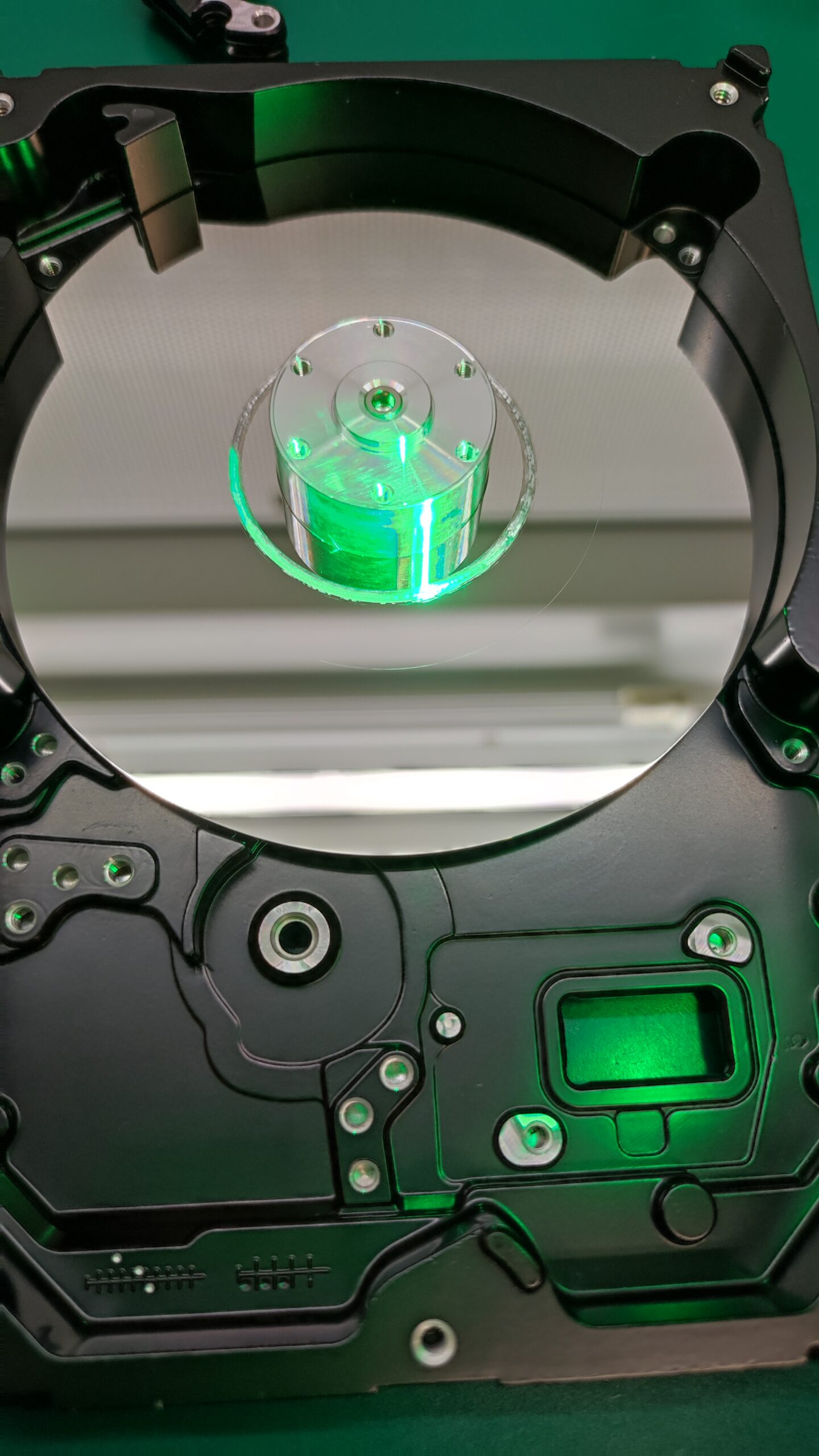
The cleaned platter was considerably clearer. Cleaning also made the underlying damage easier to assess. Fine scratches were visible slightly inside the midpoint, while the outer region proved to be in better condition than the debris had initially suggested.
The drive uses both sides of its two platters, for a total of four heads and four recording surfaces. Numbering those surfaces from bottom to top as S0 through S3, we assessed the damage as follows:
- S3: Approximately 2 mm-wide scratch in the landing zone
- S2: Approximately 2 mm-wide landing-zone scratch, plus fine scratches from roughly 40% to 50% of the radial distance from the inner diameter
- S1: Approximately 2 mm-wide landing-zone scratch, an additional scratch around the 40% position, and fine scratches from roughly 40% to 50%
- S0: Approximately 2 mm-wide landing-zone scratch, another scratch near the midpoint, and damage near the outer edge
The landing zone is where the heads rest when the HDD is stopped, so it is not normally used to store user data. The percentage positions above describe the approximate radial location, with the inner diameter treated as 0 and the outer edge as 1.
Every surface was damaged; only S3 was in comparatively reasonable condition. All four heads had failed and had to be replaced.
Because the landing-zone scratches were extremely severe, we used a specialized method to spin up the drive. A conventional startup would have destroyed the heads before the platters reached operating speed. Damage also affected a surface containing the service area, where the drive’s firmware is stored, so a nonstandard initialization procedure was required to bring the HDD into a state where data could be transferred.
Ultimately, we imaged approximately 70% of the drive. This yielded about 290 GB of files with no read errors. Another 260 GB contained one or more errors, and approximately 260 GB could not be opened. Given the condition of the media, we consider this a strong result. Spot checks also showed that many files in the damaged category remained usable.
Read errors cannot be eliminated entirely when the recording surface itself has been physically destroyed. Customers still need a clear way to understand what has and has not been recovered. We therefore provide a file-level report showing the error rate for each recovered file.
In this case, we recovered almost all file records, allowing us to prepare a detailed list of intact, damaged, and unrecoverable files. The customer found the required files in that list and approved delivery.
Very few recovery providers can retrieve useful data from an HDD in this condition. If your drive has been declared unrecoverable because of severe platter damage, contact Scratch Lab for a second assessment.
About the Author

A.N
Certified Information Security Specialist. Began career as a technical officer with the National Police Agency, specializing in digital forensics. Recipient of multiple commendations, including the Director of Information and Communications Bureau Award and the Commandant's Award from the NPA Information and Communications School.
Subsequently joined a major data recovery firm before moving to FIX Inc., where he handles the full recovery workflow — from logical to physical failures — across HDD, SSD, flash memory, and RAID systems. His specialty is severe physical damage to HDDs; he manages nearly 100 scratch damage cases annually, successfully recovering data in the majority of them.